





A webinar can attract a large audience and still produce almost no commercial value. In India, a campaign with 1,000 registrations may result in only about 410 to 460 live attendees, based on India-focused benchmark reporting, while product demonstrations can reach 50% to 65% registration-to-attendance and thought-leadership sessions may reach only 30% to 40% according to the cited India webinar benchmarks. The uncomfortable lesson is simple: registration volume is often the easiest metric to improve and the least useful one to optimise.
Effective webinar digital marketing treats the session as a pipeline asset, not a calendar event. The topic, audience, landing page, reminder journey, live interaction, replay, and sales follow-up must all point towards a qualified commercial action. India's audience makes that operating model more demanding, because mobile usage, regional-language preferences, video discovery, WhatsApp, SMS, and email all influence how people find and consume content.
Table of Contents
- Why Most Webinars Fail Before They Start
- The Attendance Funnel and Where It Leaks
- Promoting a Webinar to a Mobile-First Indian Audience
- Picking the Right Tech Stack Without Overbuying
- Running a Session That Earns Attention, Not Just Attendance
- Post-Webinar Follow-Up That Moves Pipeline
- Measuring What Matters
Why Most Webinars Fail Before They Start
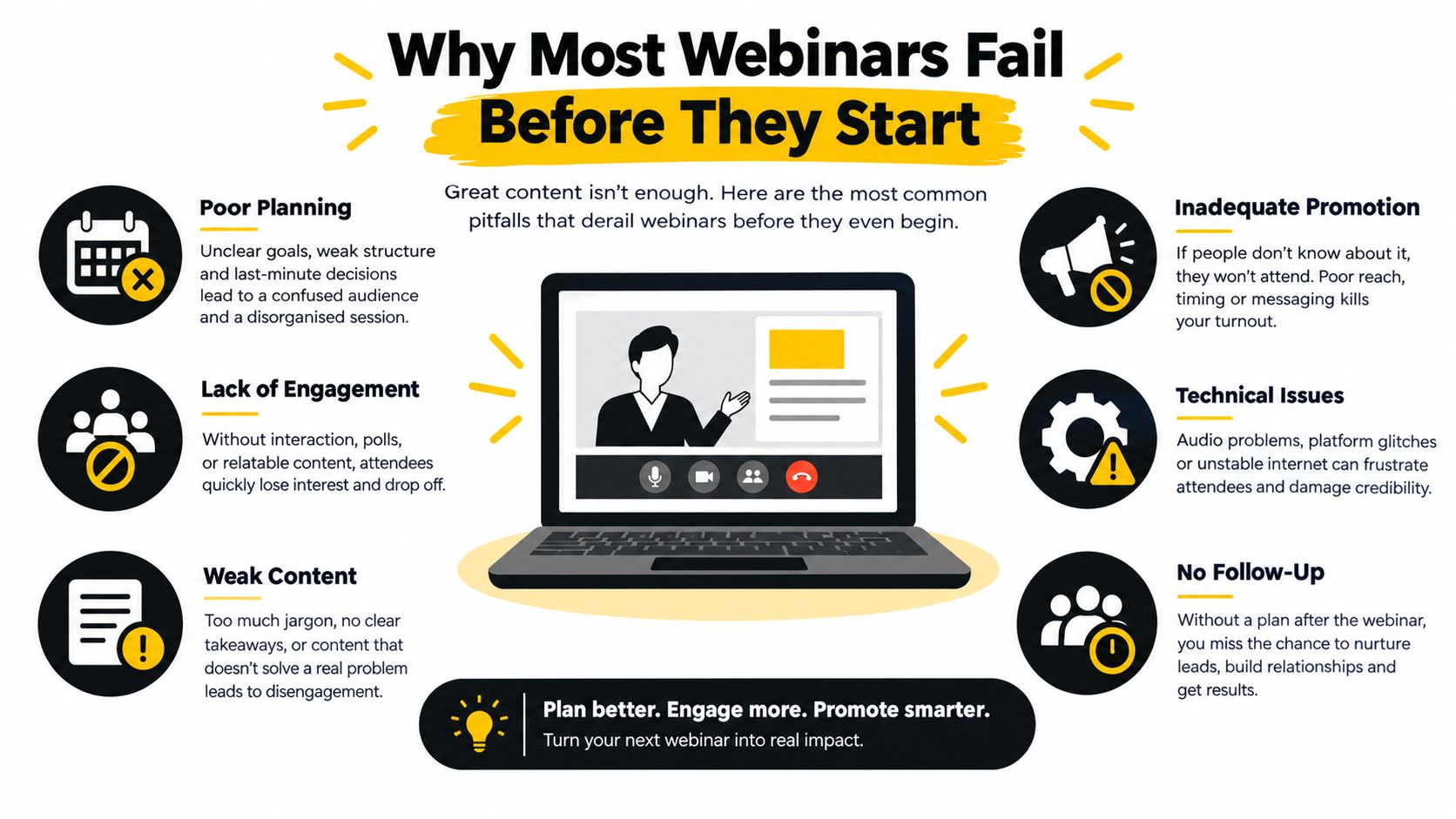
Most webinars fail because marketers optimise registration volume instead of pipeline. A broad subject attracts curious people, a low-friction form inflates the database, and a polished event creates plenty of activity. Yet sales receives contacts with weak intent, unclear fit, and no obvious reason to take the next step.
The failure usually happens before promotion begins. Teams choose a title, book speakers, and design creative before answering three commercial questions:
- Which buying-stage problem does this session address?
- Which role needs the answer badly enough to attend?
- What measurable action should follow the session?
If those answers are vague, the webinar will probably create a vague audience. A finance leader comparing implementation options needs a different session from a practitioner looking for tactical education. A prospect evaluating vendors also needs a different next step from someone who has only recognised a problem.
Start with pipeline evidence
Review recent sales calls, lost-deal notes, support conversations, and opportunity stages. Look for repeated questions that indicate friction, uncertainty, or a stalled decision. Those questions are more valuable than a fashionable theme because they reveal the language buyers already use.
A useful topic connects one audience, one problem, and one outcome. “Digital Transformation” is too broad. A sharper version might be “How Operations Leaders Can Reduce Reporting Delays Without Replacing Their Core Systems”. The second title identifies a role, a concern, and a practical decision. It also gives the speaker a boundary, which keeps the session useful rather than turning it into a tour of industry buzzwords.
Pressure-test the promise against actual conversations:
- Audience: Can you name the role, organisation type, and buying context?
- Problem: Does the topic reflect a recurring obstacle in active opportunities?
- Proof: Can the speaker demonstrate a process, decision framework, or implementation example without making unsupported promises?
- Next step: Is there a natural action after attendance, such as an assessment, consultation, product demonstration, or implementation workshop?
Practical rule: If the sales team can't explain why a qualified prospect should attend, the title isn't ready for promotion.
Run a short diagnostic
Apply the questions below to your last three webinars. Count how often the answer is clear rather than flattering.
- Did the topic map to a named pipeline problem?
- Did the registration form identify role, organisation, or buying context?
- Did the session promise a practical outcome rather than general awareness?
- Did the primary CTA match the audience's likely buying stage?
- Did follow-up change according to attendance, participation, and replay behaviour?
A weak result doesn't mean webinars are ineffective. It means the event was designed as content distribution instead of demand generation. The fix is to write the session promise before choosing the date:
For [specific role] facing [specific problem], this session will show [specific approach], so they can [measurable next action].
That sentence should guide the landing page, creative, polls, speaker brief, CTA, and sales routing. If any of those assets target a different audience or outcome, the campaign is already leaking relevance.
The Attendance Funnel and Where It Leaks
Attendance is only one point in the journey from a landing-page visit to a qualified commercial conversation. Registration volume can look healthy while intent, attention, and buying fit disappear at later stages.
India-focused benchmark reporting places registration-to-attendance at approximately 41% to 46%, with product demonstrations performing at 50% to 65% and thought-leadership sessions at 30% to 40% as noted in the cited benchmark analysis. Treat these figures as directional because audiences and methodologies differ. The practical lesson remains consistent: a large registration list is not the same as a live audience.
Track the funnel in order:
| Funnel stage | Metric that should govern it | Why it matters |
|---|---|---|
| Landing-page visit to registration | Registration conversion by traffic source | Tests whether the promise and page fit the audience |
| Registration to live attendance | Attendance rate by segment | Separates genuine intent from low-quality acquisition |
| Attendance duration | Retention through key moments | Shows whether the session holds attention |
| Live interaction | Poll, Q&A, and chat participation | Adds intent and objection data |
| Attendee to MQL | Qualified-attendee conversion | Tests engagement against commercial fit |
| MQL to pipeline | Opportunity creation and value | Links webinar activity to revenue work |
Find the expensive leak
Strong page conversion followed by weak attendance usually points to reminder timing, calendar handling, session timing, or audience quality. Healthy attendance with little interaction signals a session-design problem. Active questions with few meetings suggest a weak CTA, poor qualification, or an unprepared sales handoff.
Interactive webinars have produced about 38% attendee-to-MQL conversion, compared with roughly 19% for passive, slide-led sessions, according to the India-focused benchmark reporting cited earlier. Results will vary, but the commercial implication is clear. Polls, Q&A, and chat are not decorative features. They reveal the prospect's problem, urgency, objections, and appropriate follow-up path.
For India-based campaigns, the handoff should also account for how prospects respond after the live session. A registrant who misses the event may need a replay link through a consent-based messaging channel. An attendee who asks about implementation may belong in a sales queue, while a passive viewer may need a focused educational sequence. CPaaS-driven routing can make these distinctions actionable without treating every registration as a sales lead.
Fix the stage causing the largest commercial loss before improving registration creative. Then compare downstream movement, not just the size of the top-of-funnel chart. A webinar earns its place in the programme when attendance produces qualified conversations and pipeline, not when registrations merely increase.
Promoting a Webinar to a Mobile-First Indian Audience
India shouldn't be treated as a single English-speaking email list. The IAMAI and Kantar Internet in India 2024 findings recorded 886 million active internet users, including 397 million urban users and 488 million rural users. Users spent an average of 90 minutes per day online, and 870 million users, or 98% of internet users, accessed the internet in Indic languages. The same source reports that 57% of urban users preferred online content in Indic languages.
That changes the promotion brief. A desktop landing page, English-only creative, and email-only reminder flow will exclude reachable prospects before the sales team ever sees them.
Build the runway around behaviour
Start with one core promise, then adapt the route into the session:
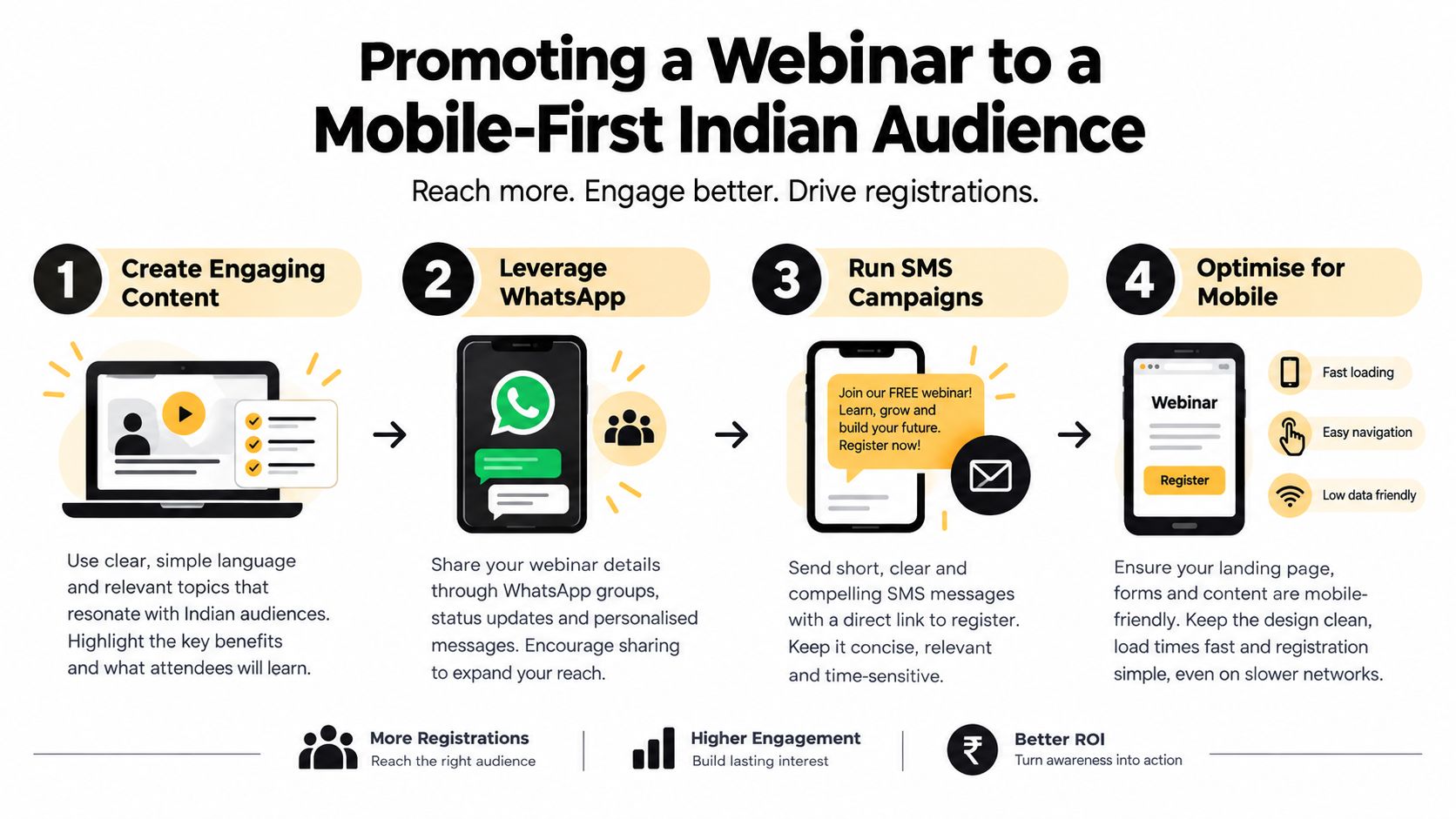
- Create short teaser clips for video and social feeds. Show the problem, objection, or decision the webinar will address rather than displaying a generic speaker announcement.
- Build a lightweight registration page with one conversion action, clear speaker credibility, and only the qualification fields needed for routing.
- Offer click-to-WhatsApp registration where the audience is more responsive to messaging than email. Use consent-based messaging and make the next action obvious.
- Send a confirmation immediately, followed by calendar instructions and timed reminders through the channels the registrant has permitted.
- Retarget registrants who haven't attended with a concise reminder and retarget no-shows with the replay rather than another invitation.
Segment paid and organic promotion by role, industry, geography, and language. A regional-language teaser can communicate the same commercial promise as an English version while using different examples and cultural references. Keep the landing page mobile-compatible, captions on video, and the replay easy to watch on a phone.
Online video strengthens the case for this approach. Ormax Media estimated India's online-video audience at 547.3 million people in 2024, with 97% using smartphones and 81% watching online video exclusively on smartphones in its 2024 OTT Audience Report summary. That doesn't predict webinar attendance, but it does tell you where discovery and replay consumption are likely to happen.
A two-week runway works best when each touch adds information. Early promotion establishes the problem, the middle phase introduces the speaker and practical outcome, and the final phase removes attendance friction. Don't send the same invitation repeatedly. Change the reason to attend.
Picking the Right Tech Stack Without Overbuying
The right webinar stack is not the one with the longest feature list. It's the one that captures identity and behaviour accurately enough for marketing and sales to act on the data.
At minimum, confirm that the setup can handle registration logic, reliable hosting, recording, replay access, attendance duration, interaction events, CRM synchronisation, and consent-based WhatsApp or SMS messaging. If the platform can't distinguish a registrant from a live attendee or a replay viewer, your follow-up will be blunt.
Match the deployment to the job
| Deployment pattern | Best fit | What you trade off |
|---|---|---|
| Light | Small teams validating a topic or running a focused session | Lower cost and faster setup, but limited automation and behavioural data |
| Integrated | Demand teams connecting forms, CRM, advertising, and messaging | Better routing and reporting, with more implementation and governance |
| Enterprise | Large programmes with complex permissions, multiple audiences, and mature operations | Broad control and scale, but higher cost, administration, and underused features |
A light setup can work when the primary objective is learning. Use a dependable meeting platform, a conversion-focused form, a CRM connection, and a separate replay page. Don't buy advanced engagement modules before proving that the topic and audience produce qualified conversations.
An integrated stack becomes worthwhile when multiple teams need the same data. Connect the registration page to the CRM, pass source and campaign information into contact records, send attendance events back after the session, and trigger CPaaS reminders from consented phone numbers. Store poll responses and CTA clicks as behavioural signals, not as notes trapped inside the webinar platform.
Enterprise tooling earns its place when the operating model demands it. Multiple business units, account-based routing, regional compliance, complex permissions, and high-volume reporting can justify the investment. Without those requirements, feature density often creates training work instead of pipeline.
The irrecoverable cost isn't always the subscription. It's losing the attendee and intent data that sales needed after the event.
Running a Session That Earns Attention, Not Just Attendance
A session earns pipeline when it creates useful buying signals, not when it fills the attendee count. Open with the buyer's problem, define the outcome, and show why the speaker can address it from practical experience. Avoid spending the first minutes on company history.
Design the core session for 35 to 45 minutes. A common benchmark range puts retention near 73% for 35 to 45-minute webinars versus about 51% for 60-minute sessions in an India webinar marketing analysis. Treat that range as a design guide, not a promise.
Use a repeatable session skeleton
- Minute 0 to 3: State the problem, audience, and outcome. Keep the introduction brief.
- Minute 3 to 8: Run a poll about role, current process, or urgency. Explain how the response will shape the discussion.
- Minute 8 to 25: Teach a working framework through examples and decisions, rather than a catalogue of features.
- Minute 25 to 32: Use moderated Q&A to address budget ownership, implementation risk, and internal approval.
- Minute 32 to 38: Present the downloadable implementation asset and primary CTA while attention remains high.
- Minute 38 to 45: Answer final questions, repeat the next step, and explain where attendees can access the replay.
For a mobile-first Indian audience, keep slides readable on a small screen and make key instructions easy to follow without audio. If the audience spans regions or language preferences, clarify terminology and offer supporting material in the languages your sales process can handle.
Polls should qualify interest. “Which industry are you in?” matters only if the answer changes routing or content. “Which obstacle is delaying your current project?” can reveal a high-intent problem and give sales a relevant opening through email, WhatsApp, or another consented CPaaS channel.
The downloadable asset should justify the follow-up. A checklist, diagnostic worksheet, implementation plan, or decision framework gives attendees a useful next action and gives the team a signal to track.
Passive slide reading creates attendance with little evidence of buying relevance. Questions, repeated poll responses, and asset downloads provide stronger signals than registration alone.
Post-Webinar Follow-Up That Moves Pipeline
The live session is the midpoint, not the finish line. Pipeline develops after the event, when the team interprets behaviour and gives each audience segment a relevant next action. Registration and attendance show reach. Questions, replay depth, asset downloads, and replies show buying interest.
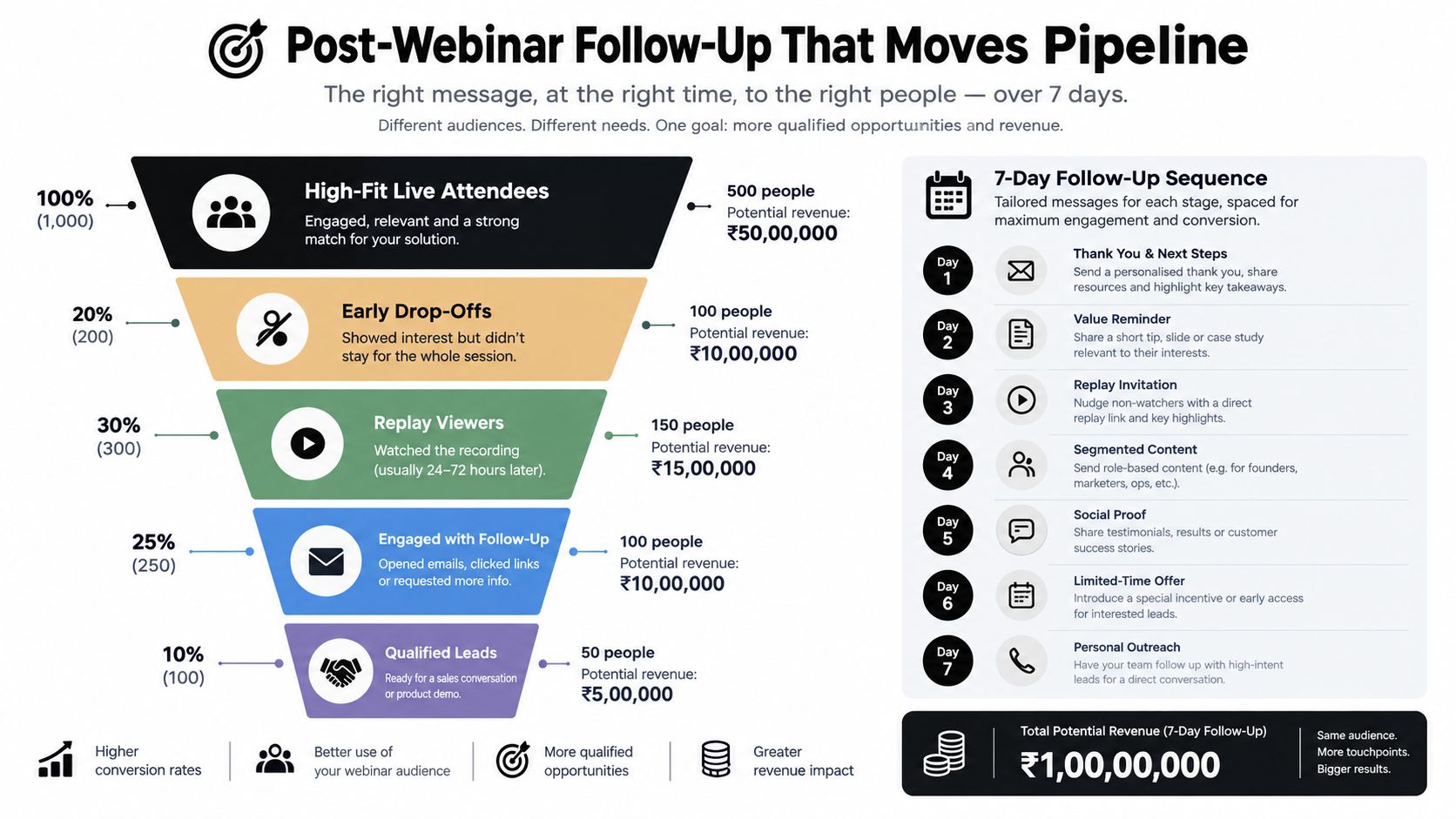
Use a seven-day follow-up motion, with different routes for different signals. A high-fit attendee who asked a detailed implementation question deserves a different message from a registrant who never joined. Replay viewing creates a second opportunity, not an administrative task.
Route by signal
Day 0: Send attendees the recording and promised asset. Give no-shows the replay. Keep the CTA separate from the viewing link so the next action can be measured.
Day 1: Sales should contact high-fit attendees who showed intent through questions, poll responses, asset downloads, or direct replies. Refer to the problem they engaged with, rather than repeating the event summary.
Day 2 or 3: Send educational content to attendees who watched but interacted little. A useful explanation, checklist, or related example can build relevance before a meeting request.
Day 4: Use WhatsApp or SMS only with consent and only when the message adds value. A short prompt can ask whether the recipient wants help applying the framework. Repeated reminders create fatigue quickly, particularly across mobile-first audiences.
Day 5 to 7: Re-engage replay viewers and qualified non-attendees with a focused CTA. Match the offer to their behaviour, such as the section they watched or the asset they downloaded. For multilingual audiences, use the language and channel your sales process can support.
Score attendee quality using firmographic fit and observed intent. Fit may include account type, role, industry, or geography. Intent may include live participation, high-value questions, poll answers, replay depth, WhatsApp replies, and booked meetings. A high-fit person with low engagement is not automatically an opportunity. A lower-fit viewer with a specific implementation question may still merit human review.
A staged follow-up works best: confirmation, calendar and timed reminders, interactive elements, a downloadable asset, and a seven-day sales nurture sequence. The sequence length matters less than the connection between each message and a recorded behaviour. CPaaS channels can speed that response, but consent, message relevance, and clear routing still determine whether they create conversations or fatigue.
Follow-up principle: Send the next most relevant action, not the next scheduled message.
Measuring What Matters
A registration dashboard can look healthy while the sales pipeline stays empty. Measure the actions that indicate buying intent and the stages that follow, rather than stopping at registrations or live attendance.
The India webinar operating model described by Aon Meetings recommends tracking landing-page visits to registration, registration to live attendance, attendance duration, poll and Q&A participation, attendee to MQL, MQL to meeting, and meeting to pipeline. This sequence separates audience activity from commercial progress.
Build the measurement loop
Track every contact through a consistent event model:
- Acquisition: source, campaign, audience segment, language, geography, and device.
- Participation: registration, attendance, duration, poll response, question, chat activity, and asset download.
- Continuation: replay view, replay depth, WhatsApp reply, SMS response, meeting request, or CTA click.
- Commercial outcome: MQL acceptance, meeting held, opportunity created, and pipeline progression.
Leadership usually needs two outcome measures: cost per qualified attendee and cost per opportunity. Cost per registration can diagnose media efficiency, but it should not define success. Low-cost registrations from a poorly matched audience can increase follow-up workload while reducing sales confidence.
Connect paid media to post-event behaviour. Replay viewers can form a retargeting group for a related decision asset. High-intent attendees can leave broad awareness campaigns and enter sales-focused messaging. Use objections and poll answers to improve the next creative. If buyers repeatedly ask about implementation, address implementation in the next teaser instead of repeating the original headline.
Use a launch checklist
Before promotion begins, confirm that:
- the topic maps to a real pipeline problem;
- the registration page has one clear action;
- qualification fields support routing;
- attendance and engagement events reach the CRM;
- consent is recorded for WhatsApp and SMS;
- the replay has its own CTA;
- sales has segment-specific follow-up copy;
- reporting includes meetings and opportunities;
- media audiences can be built from post-event behaviour.
A webinar programme earns further investment when each event improves the next. Registration data informs targeting, audience questions improve content, replay behaviour sharpens retargeting, and opportunity outcomes guide topic selection.
TVL Media connects webinar strategy with creative production, paid media, WhatsApp and SMS CPaaS workflows, landing pages, and pipeline reporting. Visit TVL Media to plan a mobile-first webinar programme that measures qualified actions and opportunities, not just registrations.
Drafted with Outrank tool

