


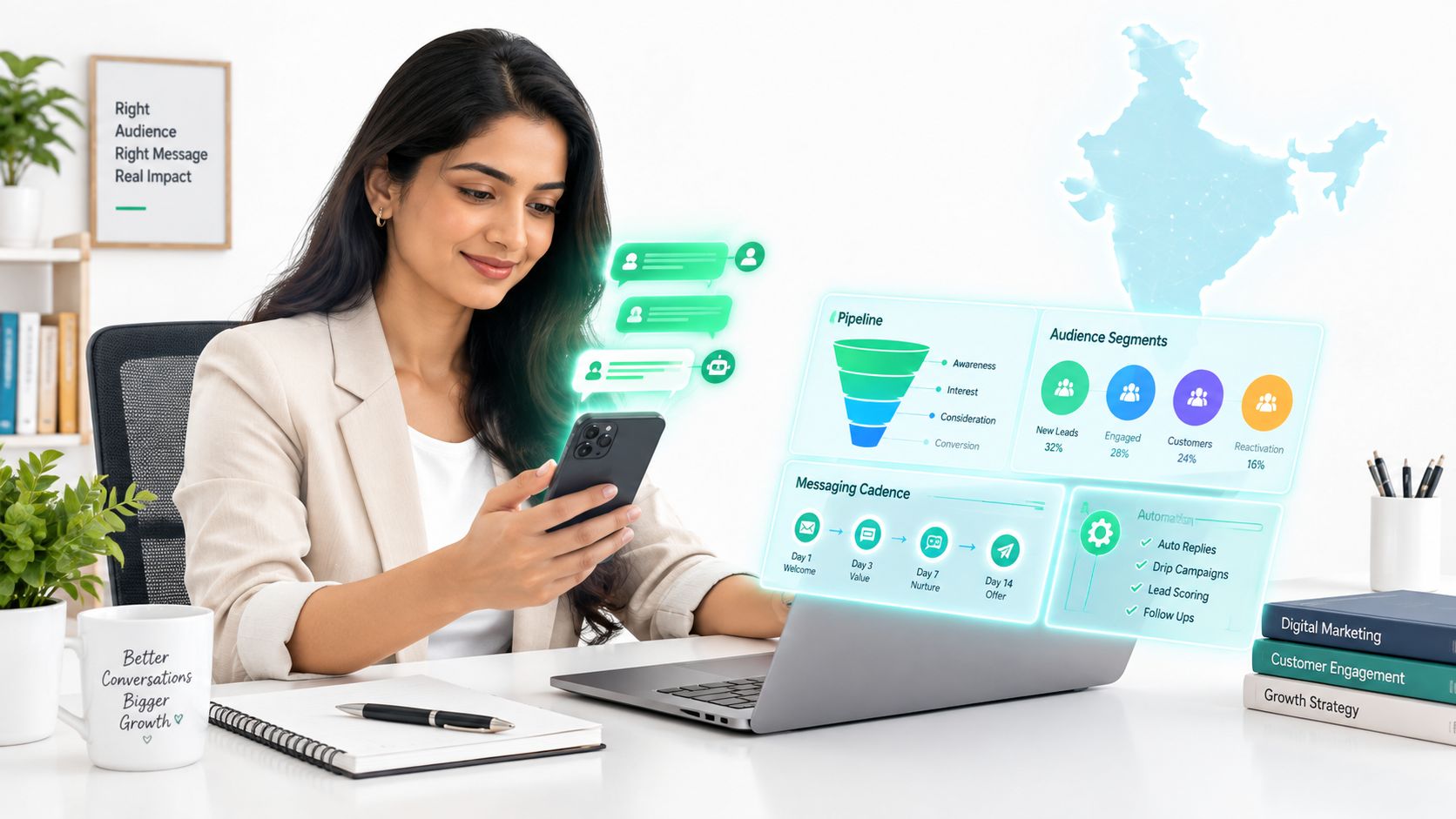


India's WhatsApp audience is already above 535.8 million users, so the channel is too big to treat as a support-only inbox. A strong WhatsApp marketing strategy in India should behave like an accountable growth layer, tied to cost per order, pipeline, and retention.
Treating WhatsApp as a broadcast list is the fastest way to waste it. The better model is a connected system where paid media, consent capture, conversational qualification, CRM stages, and post-purchase follow-up all feed one another.
Table of Contents
- Rethinking WhatsApp as a Growth Channel
- Why India Demands a Different WhatsApp Strategy
- Building a Consent-First WhatsApp Workflow
- Choosing Message Types and Cadence by Goal
- Integrating WhatsApp with CRM, Ads, and Orders
- Measuring Incremental Pipeline Impact
- Your WhatsApp Marketing Strategy Checklist
Rethinking WhatsApp as a Growth Channel
Teams still use WhatsApp like a convenience layer, a place to dump updates after the core campaign is already live. That habit misses the point. The audience scale covered in the next section changes how you should plan, target, and report, because WhatsApp can shape acquisition, sales, service, and repeat purchase at the same time. The channel has to be managed like a measurable growth asset, not a side inbox.
Stop optimising for sends
Delivery volume is a weak north star. A message can be delivered, read, and even replied to without creating meaningful revenue, especially when the same audience sees repeated nudges across channels. The key question is whether the conversation moved someone closer to an order, a qualified opportunity, or a retained account.
Practical rule: if a WhatsApp campaign cannot be tied to a downstream business event, it is not a growth campaign, it is just messaging.
That changes the operating model. Paid media should drive opt-ins or click-to-WhatsApp conversations. WhatsApp should qualify intent. CRM should show which conversations became orders or pipeline. Once the channel works this way, creative decisions get sharper because you can see which angles produce outcomes and which ones only generate noise.
Build a feedback loop, not a blast list
Strong programmes do not end when the message is sent. They end when the next brief is better. Reply patterns, opt-outs, and qualified conversations from one campaign should shape the next landing page, audience segment, offer, or sales sequence.
WhatsApp also becomes useful beyond retention. It becomes a test bed for offers, a qualification layer for paid traffic, and a fast path from curiosity to action. If your team cannot point to the cost per order or pipeline value attached to a campaign, the programme is still too shallow.
Why India Demands a Different WhatsApp Strategy
India forces WhatsApp strategy to be operational, not decorative. The channel is already a default business touchpoint, so the win is not volume, it is relevance at a scale where generic blasting gets ignored fast.
Scale changes the economics of relevance
A national WhatsApp program has to behave like a set of local programs. A D2C brand shipping to Tamil Nadu and Punjab should not run one national broadcast template, then hope the copy fits both markets. It should run separate Hindi-, Tamil-, or Punjabi-language threads, set different fulfilment promises where needed, and adjust offers by region and buying context. That is how you reduce friction without over-messaging people who do not need the same prompt.
Scale also raises the penalty for being vague. In India, WhatsApp is already normal business infrastructure, and industry reporting shows the app is embedded throughout MSME communication Entrepreneur India coverage. That makes the channel familiar, but it also makes lazy execution stand out. If every brand is already in the inbox, the one that wins is the one that sounds timely, specific, and locally useful.
The audience size is still worth stating once. DataReportal's Digital 2025 estimate puts India's WhatsApp audience at approximately 535.8 million users in early 2025, while industry-reported estimates in the same market sit above 500 million Aisensy's business statistics round-up. That scale is why relevance matters more than reach.
High adoption is not the same as high intent
Widespread use does not mean every message deserves the same treatment. Transactional updates, product discovery, lead qualification, and reactivation all serve different jobs, and each one needs a different cadence and tone. If a team sends the same nudge to a first-time lead, an active buyer, and a dormant customer, performance drops because the message no longer matches the stage.
Practical segmentation usually starts with a few signals:
- Language preference: match the thread to how the customer naturally communicates.
- Geography: align offers, service times, and fulfilment expectations.
- Purchase value: reserve more intensive follow-up for higher-value opportunities.
- Lifecycle stage: separate new leads, active buyers, and dormant contacts.
WhatsApp works best in India when the brand acts like a careful operator. Respect the crowding in the channel, then earn attention with timing, context, and consent.
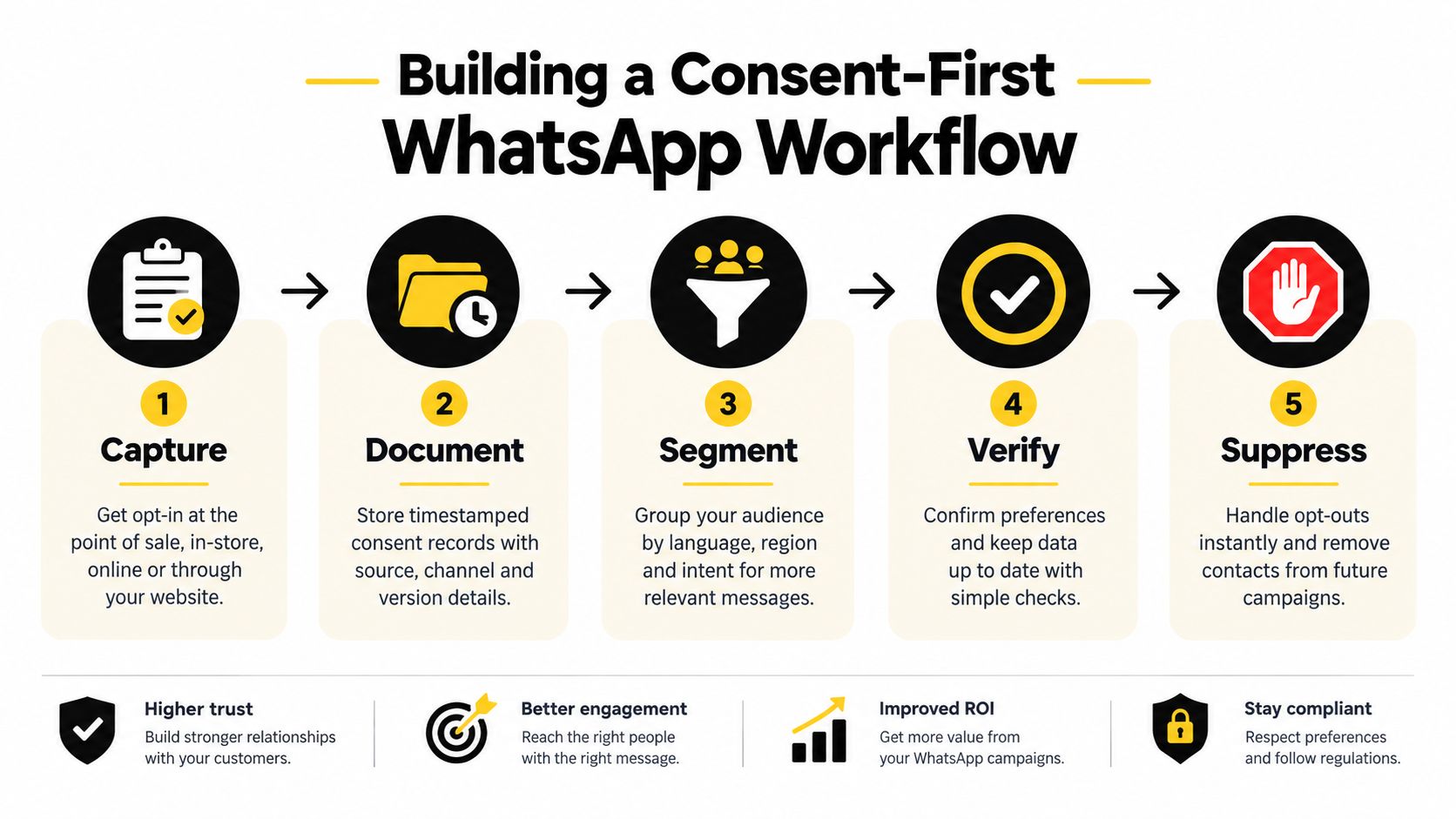
Building a Consent-First WhatsApp Workflow
Consent is the part most WhatsApp programmes under-invest in, and it's the part that protects everything else. Indian brands need a workflow that clearly separates support, transactional, and promotional use, because one permission doesn't automatically cover every future use case. India's Digital Personal Data Protection framework requires consent to be free, specific, informed, unconditional, and unambiguous, and WhatsApp's own rules also require users to opt in before receiving business messages MyOperator's India compliance guidance.
Capture consent at the moment of intent
Opt-in should happen where intent already exists. That can be a checkout flow, a lead form, a click-to-WhatsApp ad, or a service interaction. What matters is that the customer knows the business name, the message purpose, and what kind of communication they're agreeing to receive.
Store the evidence, not just the number. For each contact, keep the phone number, consent wording, timestamp, source, purpose, and withdrawal status. That record is what makes later suppression, audits, and reclassification possible when a customer changes how they want to be contacted.
Separate purposes before you automate
A delivery update is not a promotional opt-in. A support conversation is not a blanket permission to send offers forever. If your CRM treats those as interchangeable, the programme will create avoidable risk and higher complaint rates.
The cleanest model is purpose-specific consent with clear suppression logic. If a contact opts out of promotions, they can still receive fulfilment updates where appropriate, but only if that relationship has been set up correctly. That distinction sounds basic, yet it's where many Indian programmes become defensible or indefensible.
Use the workflow as a governance asset
A consent-first system gives growth, legal, and operations the same source of truth. It also makes segmentation more useful, because the customer records are cleaner from the start. That's especially important when a programme expands across multiple brands, languages, or teams.
Keep the audit trail easy to retrieve. If you can't show where consent came from, you don't really have consent architecture, you have guesswork.
Choosing Message Types and Cadence by Goal
Different WhatsApp message types should map to different business outcomes. If the message's job is to update, it should feel useful and concise. If the job is to sell, it should reduce friction and move the user toward the next step without sounding like a push notification copy-paste.
Match the format to the lifecycle stage
| Message type | Best use | Primary KPI | Risk level |
|---|---|---|---|
| Utility update | Order, booking, or account status | Response speed, completion of task | Low |
| Sales follow-up | Lead qualification or assisted close | Qualified conversations, conversion | Medium |
| Remarketing nudge | Cart recovery or offer reminder | Assisted revenue, order rate | Medium |
| Reactivation sequence | Win-back or lapsed user re-engagement | Recovered customers, repeat purchase | Higher |
The table looks simple because the complexity lives in the audience and cadence. A utility message can tolerate more frequency than a promotion because it serves a direct need. A reactivation sequence can work well, but only when the contact list is clean and the offer is clearly relevant.
Cadence should follow value, not habit
Excessive broadcasting hurts reply rates and increases opt-outs. The mistake is usually structural, not creative. Teams keep sending the same template to every segment because it's easier to manage than a more disciplined calendar.
Better programmes use language, geography, and customer value to control frequency. VIP customers can justify more personalised follow-up if the message is actually useful. Lower-intent audiences need less pressure and more precision.
Don't confuse engagement with momentum
A replied-to message isn't automatically a good outcome. It might just mean the audience is forced to ask for clarity because the template was too vague. Strong programmes remove that friction up front.
If the goal is sales, the message should answer the obvious objection, surface the next action, and route the customer to the right person or flow. If the goal is retention, the message should solve a problem or confirm progress, not fill inbox space.
Integrating WhatsApp with CRM, Ads, and Orders
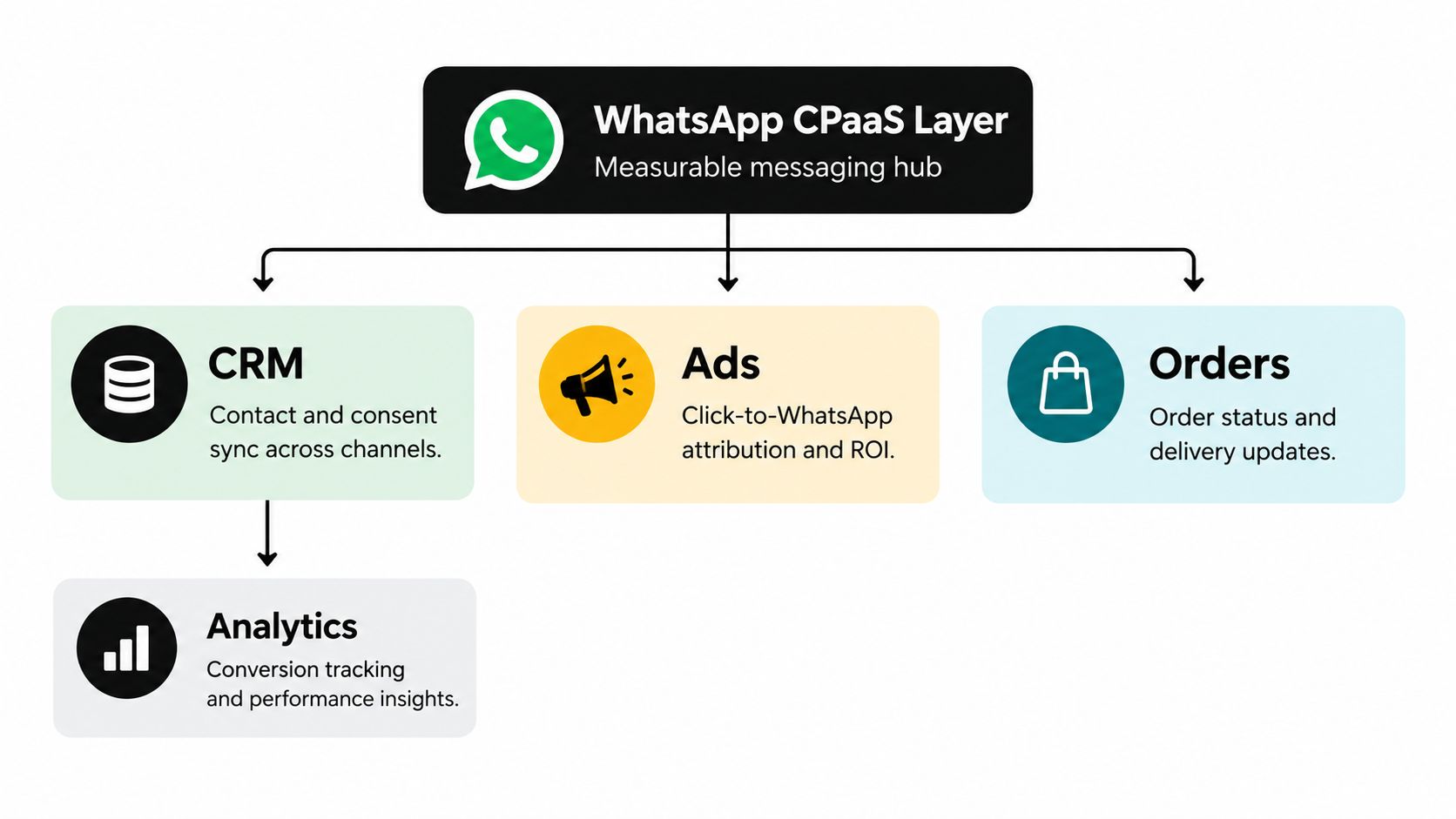
WhatsApp becomes far more valuable when it sits inside the same system as your CRM, ad platform, order engine, and support queue. That's the difference between a messaging tool and a CPaaS layer. Once click, lead, cart, payment, and delivery events are flowing into one customer data layer, the conversation can be triggered by actual behaviour rather than guesswork WhatsApp's India research resource.
Make the event stream do the work
The clean sequence is straightforward. Pass events into the customer data layer, deduplicate phone numbers, verify that consent is valid for the intended use, and only then trigger the approved template. That order matters because it prevents the common failure mode where teams message people before the system has confirmed they should be contacted.
Route conversations like a sales system
WhatsApp replies should not disappear into a general inbox. Use short reply options or structured flows to classify intent, then create CRM tasks for high-value or unresolved conversations. If a lead needs a human, the handoff should be immediate and visible to the team that owns the next step.
Common failure modes are easy to spot once the system is connected:
- Broken deep links: the message promises a path that doesn't resolve cleanly.
- Stale catalog data: the product shown in chat no longer matches inventory.
- Missing escalation paths: the customer is stuck talking to automation.
- Duplicate contacts: one person is treated like several accounts.
- No consent sync: growth sends what compliance never approved.
Build the reporting loop before volume rises
A useful WhatsApp stack reconciles exposure with orders and pipeline stages in a fixed attribution window. That's what makes the channel accountable. Without that linkage, the team ends up measuring message activity instead of business impact.
If the CRM doesn't know what happened in WhatsApp, the conversation never really happened for the business.
Measuring Incremental Pipeline Impact
High reach and high frequency can make a channel look better than it is. That's especially true in India, where reporting cited Sensor Tower data showed as many as 94% of WhatsApp's Indian monthly users opened the app daily in November, while 67% of WhatsApp Business users did so RichAutomate's WhatsApp statistics coverage. Those numbers tell you the app is heavily used, but they don't prove that a WhatsApp campaign created revenue that wouldn't have happened anyway.
Test for lift, not just activity
The best measurement model is a holdout test. Put eligible opted-in users into treatment and control groups, then compare incremental conversions rather than raw sends, opens, or replies. If the treatment group outperforms the control group on qualified outcomes, you've got evidence of lift.
Track the metrics that connect to revenue:
- Qualified-pipeline rate: how many conversations become legitimate opportunities.
- Time to conversion: how quickly a user moves from message to action.
- Assisted revenue: orders or deals where WhatsApp contributed, not necessarily closed the sale alone.
- Contactability decay: how quickly people stop responding over time.
- Incremental cost per order: what the channel costs when the control baseline is removed.
Treat cohorts differently
Utility, sales follow-up, remarketing, and reactivation all have different baseline propensities to buy. Lumping them together hides what is working. A support update that improves customer confidence is not the same as a reactivation offer that recovers dormant demand.
That distinction matters when you're deciding where to spend more. If faster response improves qualified pipeline but not total volume, the value may be in the follow-up layer rather than acquisition. In that case, WhatsApp is doing its best work after the click, not before it.
Measure the whole journey
A credible measurement stack connects ad click IDs, landing-page events, WhatsApp conversations, CRM stages, and closed revenue. That's the only way to know whether a message helped a buyer move forward or just captured a person who was already close to converting. The channel is strongest when it shortens the distance between intent and action.
Your WhatsApp Marketing Strategy Checklist
A strong whatsapp marketing strategy in India starts with consent architecture, not templates. It then moves through segmentation, message choice, system integration, and incremental measurement, in that order.
Keep the operating model disciplined
- Capture opt-in properly: collect explicit consent at checkout, in lead forms, through click-to-WhatsApp ads, or during support interactions.
- Document every consent record: store the wording, timestamp, source, purpose, and withdrawal status.
- Segment with intent: separate contacts by language, geography, lifecycle stage, and customer value.
- Choose the right message type: utility, sales follow-up, remarketing, and reactivation each need a different cadence and risk tolerance.
- Connect the systems: sync WhatsApp with CRM, ads, order data, and support so replies become measurable actions.
- Prove lift: compare treatment groups against holdouts and judge success by cost per order and pipeline value, not message volume.
The smartest programmes stay smaller and more auditable rather than chasing the biggest list. That's how you reduce complaint risk, protect delivery quality, and keep the channel useful when volume rises.
TVL Media builds WhatsApp programmes the way serious growth teams need them to work, with strategy, paid media, CPaaS, and web build tied together in one loop. If you want a WhatsApp system that's measured on cost per order and pipeline quality, visit TVL Media and start turning conversations into accountable growth.
Enhanced by Outrank app

